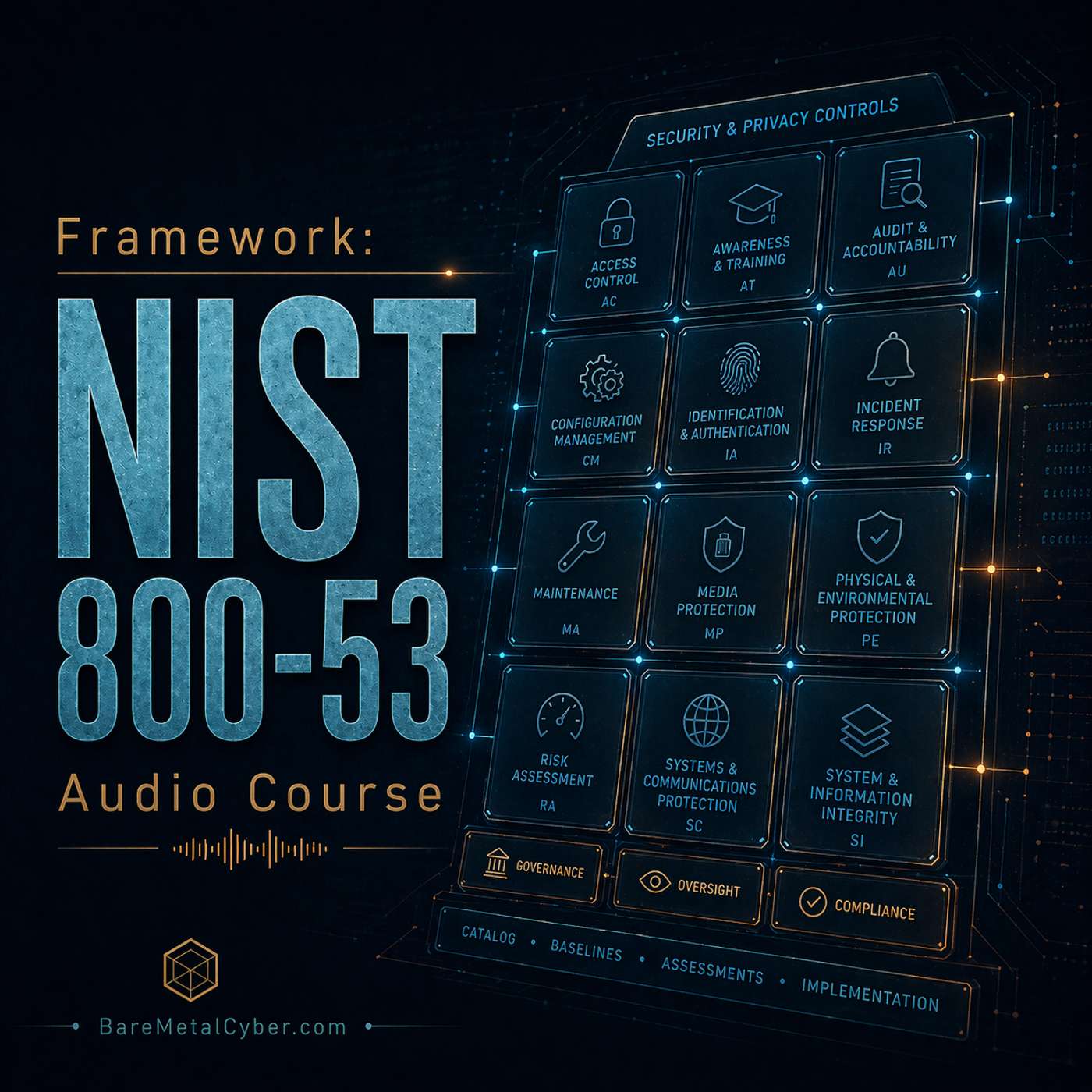
Framework: NIST 800-53 Audio Course
Episodes
Episode 47 — Contingency Planning — Part Three: Evidence, tests, and pitfalls
20 Oct 2025
Contributed by Lukas
Evidence for contingency planning demonstrates that recovery strategies are not just written but operationally validated. For the exam, candidates mus...
Episode 46 — Contingency Planning — Part Two: Backup, alternate sites, and continuity patterns
20 Oct 2025
Contributed by Lukas
Backups and alternate sites form the operational backbone of contingency planning under NIST 800-53. For exam preparation, candidates should know that...
Episode 45 — Contingency Planning — Part One: Plans, roles, and objectives
20 Oct 2025
Contributed by Lukas
Contingency planning ensures that critical missions continue despite disruptions such as cyber incidents, natural disasters, or hardware failures. In ...
Episode 44 — System and Communications Protection — Part Four: Advanced topics and metrics
20 Oct 2025
Contributed by Lukas
Advanced system and communications protection extends traditional boundary security into adaptive, context-aware controls. For exam readiness, candida...
Episode 43 — System and Communications Protection — Part Three: Evidence, coverage, and pitfalls
20 Oct 2025
Contributed by Lukas
Evidence for system and communications protection confirms that segmentation, encryption, and traffic controls function as designed. For the exam, can...
Episode 42 — System and Communications Protection — Part Two: Cryptography and session protections
20 Oct 2025
Contributed by Lukas
Cryptography within NIST 800-53 provides confidentiality and integrity for information in transit and at rest. Exam candidates must grasp that cryptog...
Episode 41 — System and Communications Protection — Part One: Segmentation and boundary thinking
20 Oct 2025
Contributed by Lukas
System and communications protection within NIST 800-53 establishes how data and traffic are isolated, filtered, and secured across system boundaries....
Episode 40 — System and Information Integrity — Part Four: Advanced topics and metrics
20 Oct 2025
Contributed by Lukas
Advanced integrity programs combine analytics, automation, and threat intelligence to predict and prevent compromise before symptoms appear. For exam ...
Episode 39 — System and Information Integrity — Part Three: Evidence, signals, and pitfalls
20 Oct 2025
Contributed by Lukas
Evidence of system and information integrity proves that protective measures function consistently and effectively. For the exam, candidates must iden...
Episode 38 — System and Information Integrity — Part Two: Flaw remediation and protection patterns
20 Oct 2025
Contributed by Lukas
Flaw remediation defines how organizations identify, prioritize, and correct vulnerabilities that threaten system integrity. NIST 800-53 requires a re...
Episode 37 — System and Information Integrity — Part One: Purpose, scope, and outcomes
20 Oct 2025
Contributed by Lukas
System and information integrity ensures that systems detect, report, and correct errors in a timely manner. Within NIST 800-53, this control family a...
Episode 36 — Risk Assessment — Part Four: Advanced topics and metrics
20 Oct 2025
Contributed by Lukas
Advanced risk assessment techniques refine precision and speed without losing transparency. For exam purposes, candidates should understand how automa...
Episode 35 — Risk Assessment — Part Three: Evidence, registers, and pitfalls
20 Oct 2025
Contributed by Lukas
Evidence in risk assessment demonstrates that inputs are accurate, analyses are reproducible, and decisions follow stated criteria. For exam readiness...
Episode 34 — Risk Assessment — Part Two: Assessment practices and prioritization
20 Oct 2025
Contributed by Lukas
Assessment practices convert contextual understanding into prioritized action. For the exam, distinguish qualitative methods that use calibrated scale...
Episode 33 — Risk Assessment — Part One: Categorization, context, and threats
20 Oct 2025
Contributed by Lukas
Risk assessment in NIST 800-53 begins with system categorization, which anchors everything that follows by aligning confidentiality, integrity, and av...
Episode 32 — Incident Response — Part Four: Advanced topics and metrics
20 Oct 2025
Contributed by Lukas
Advanced incident response integrates automation, threat intelligence enrichment, and cross-domain rehearsals to compress dwell time and standardize o...
Episode 31 — Incident Response — Part Three: Evidence, timing, and pitfalls
20 Oct 2025
Contributed by Lukas
Evidence in incident response must show what happened, when it happened, who acted, and how decisions were made. For the exam, focus on the principle ...
Episode 30 — Incident Response — Part Two: Implementation patterns and roles
20 Oct 2025
Contributed by Lukas
Implementing incident response effectively requires aligning roles, processes, and tools around a clear command structure. For exam readiness, candida...
Episode 29 — Incident Response — Part One: Purpose, scope, and maturity markers
20 Oct 2025
Contributed by Lukas
Incident response under NIST 800-53 defines how organizations detect, analyze, contain, and recover from cybersecurity events. For the exam, candidate...
Episode 28 — Configuration Management — Part Four: Advanced topics and metrics
20 Oct 2025
Contributed by Lukas
Advanced configuration management integrates continuous compliance verification, automated rollback, and predictive analytics to prevent drift before ...
Episode 27 — Configuration Management — Part Three: Evidence, sampling, and pitfalls
20 Oct 2025
Contributed by Lukas
Evidence in configuration management proves that baselines are defined, implemented, and enforced. Candidates must recognize that sufficient evidence ...
Episode 26 — Configuration Management — Part Two: Build patterns and approvals that scale
20 Oct 2025
Contributed by Lukas
Building scalable configuration management processes requires defining repeatable patterns and governance checkpoints that sustain control integrity a...
Episode 25 — Configuration Management — Part One: Baselines, change control, and integrity
20 Oct 2025
Contributed by Lukas
Configuration management defines how systems maintain secure, consistent, and verifiable states over time. In NIST 800-53, configuration controls ensu...
Episode 24 — Audit and Accountability — Part Four: Advanced topics and metrics
20 Oct 2025
Contributed by Lukas
Advanced auditing extends beyond compliance into proactive security intelligence. For the exam, candidates must grasp how metrics transform raw log da...
Episode 23 — Audit and Accountability — Part Three: Evidence, coverage checks, and pitfalls
20 Oct 2025
Contributed by Lukas
Evidence for audit and accountability controls verifies that logging, review, and retention processes are functioning as described. Candidates prepari...
Episode 22 — Audit and Accountability — Part Two: Collection, transport, and retention patterns
20 Oct 2025
Contributed by Lukas
Collecting and retaining audit records securely ensures that data remains accurate, complete, and accessible for analysis. Under NIST 800-53, audit re...
Episode 21 — Audit and Accountability — Part One: Logging purpose, scope, and event taxonomy
20 Oct 2025
Contributed by Lukas
Audit and accountability controls within NIST 800-53 ensure that system activities are recorded, traceable, and reviewable to detect misuse or policy ...
Episode 20 — Identification and Authentication — Part Four: Advanced topics and metrics
20 Oct 2025
Contributed by Lukas
Advanced identification and authentication approaches align with zero trust architectures, emphasizing continuous validation rather than one-time logi...
Episode 19 — Identification and Authentication — Part Three: Evidence across the credential lifecycle
20 Oct 2025
Contributed by Lukas
Evidence for identification and authentication controls demonstrates that identity verification, credential issuance, and periodic validation occur as...
Episode 18 — Identification and Authentication — Part Two: Implementation patterns and enrollment
20 Oct 2025
Contributed by Lukas
Implementing identification and authentication within NIST 800-53 involves lifecycle management, from identity proofing to credential issuance, renewa...
Episode 17 — Identification and Authentication — Part One: Authentication goals and threats
20 Oct 2025
Contributed by Lukas
Identification and authentication underpin every security boundary. In NIST 800-53, this control family ensures that entities prove who they are befor...
Episode 16 — Access Control — Part Four: Advanced topics and metrics
20 Oct 2025
Contributed by Lukas
Advanced access control concepts expand from traditional identity enforcement into dynamic, context-aware decision-making. Within NIST 800-53, advance...
Episode 15 — Access Control — Part Three: Evidence, reviews, and pitfalls
20 Oct 2025
Contributed by Lukas
Evidence in the access control domain confirms that permissions are granted appropriately and reviewed regularly. For NIST 800-53, this involves maint...
Episode 14 — Access Control — Part Two: Implementation patterns and guardrails
20 Oct 2025
Contributed by Lukas
Implementation of access control requires balancing usability with enforcement strength. NIST 800-53 outlines patterns that include mandatory, discret...
Episode 13 — Access Control — Part One: Principles, risks, and outcomes
20 Oct 2025
Contributed by Lukas
Access control defines how organizations enforce the principle of least privilege and protect information from unauthorized use or disclosure. Within ...
Episode 12 — Always-Ready Rhythm — Updates, reviews, and renewals
20 Oct 2025
Contributed by Lukas
An always-ready rhythm ensures that security documentation, control performance, and risk posture remain current without waiting for formal assessment...
Episode 11 — Documentation Quality — Narratives that survive scrutiny
20 Oct 2025
Contributed by Lukas
In NIST 800-53 programs, documentation quality directly determines how well an organization can defend its security posture during assessments. The Sy...
Episode 10 — Tailoring Workflow — From assumption to parameter
20 Oct 2025
Contributed by Lukas
Tailoring in NIST 800-53 refers to the process of adjusting control sets to fit specific system missions, environments, and technologies while maintai...
Episode 9 — Metrics — Choosing numbers that drive action
20 Oct 2025
Contributed by Lukas
Metrics transform control performance into measurable insights that inform management and improvement. In the NIST 800-53 context, metrics should alig...
Episode 8 — Continuous Monitoring — Cadence, triggers, and tiles
20 Oct 2025
Contributed by Lukas
Continuous monitoring within the NIST 800-53 program extends the assessment process beyond the authorization decision, transforming security into an o...
Episode 7 — Sampling — Populations, periods, and selection logic
20 Oct 2025
Contributed by Lukas
Sampling enables assessors and auditors to test representative subsets of evidence without examining every instance, saving time while maintaining con...
Episode 6 — Evidence — Definitions, sufficiency, and traceability
20 Oct 2025
Contributed by Lukas
Evidence in the NIST 800-53 framework forms the backbone of any credible assessment or authorization decision. It verifies that controls are not only ...
Episode 5 — Roles and Artifacts — SSP, SAP, SAR, and POA&M that agree
20 Oct 2025
Contributed by Lukas
Every NIST 800-53 program depends on clear roles and aligned artifacts. The System Security Plan (SSP) documents control implementation, the Security ...
Episode 4 — Parameters and ODPs — Making controls fit your system
20 Oct 2025
Contributed by Lukas
Parameters and organizationally defined parameters, or ODPs, give NIST 800-53 its flexibility by allowing organizations to specify how controls apply ...
Episode 3 — Scoping and Inheritance — Boundaries, providers, and proofs
20 Oct 2025
Contributed by Lukas
Scoping and inheritance define where responsibility begins and ends within a system authorization boundary. In NIST 800-53, scoping determines which c...
Episode 2 — Baselines and Overlays — Tailoring you can defend
20 Oct 2025
Contributed by Lukas
Baselines and overlays within NIST 800-53 define how control selections scale across systems of differing impact levels and mission contexts. Baseline...
Episode 1 — Foundations — Why NIST 800-53 still anchors real programs
20 Oct 2025
Contributed by Lukas
NIST Special Publication 800-53 remains the cornerstone of modern cybersecurity compliance because it provides a unified control catalog that integrat...