Menu
Sign In Search Podcasts Charts People & Topics Add Podcast API Pricing
Podcast Image

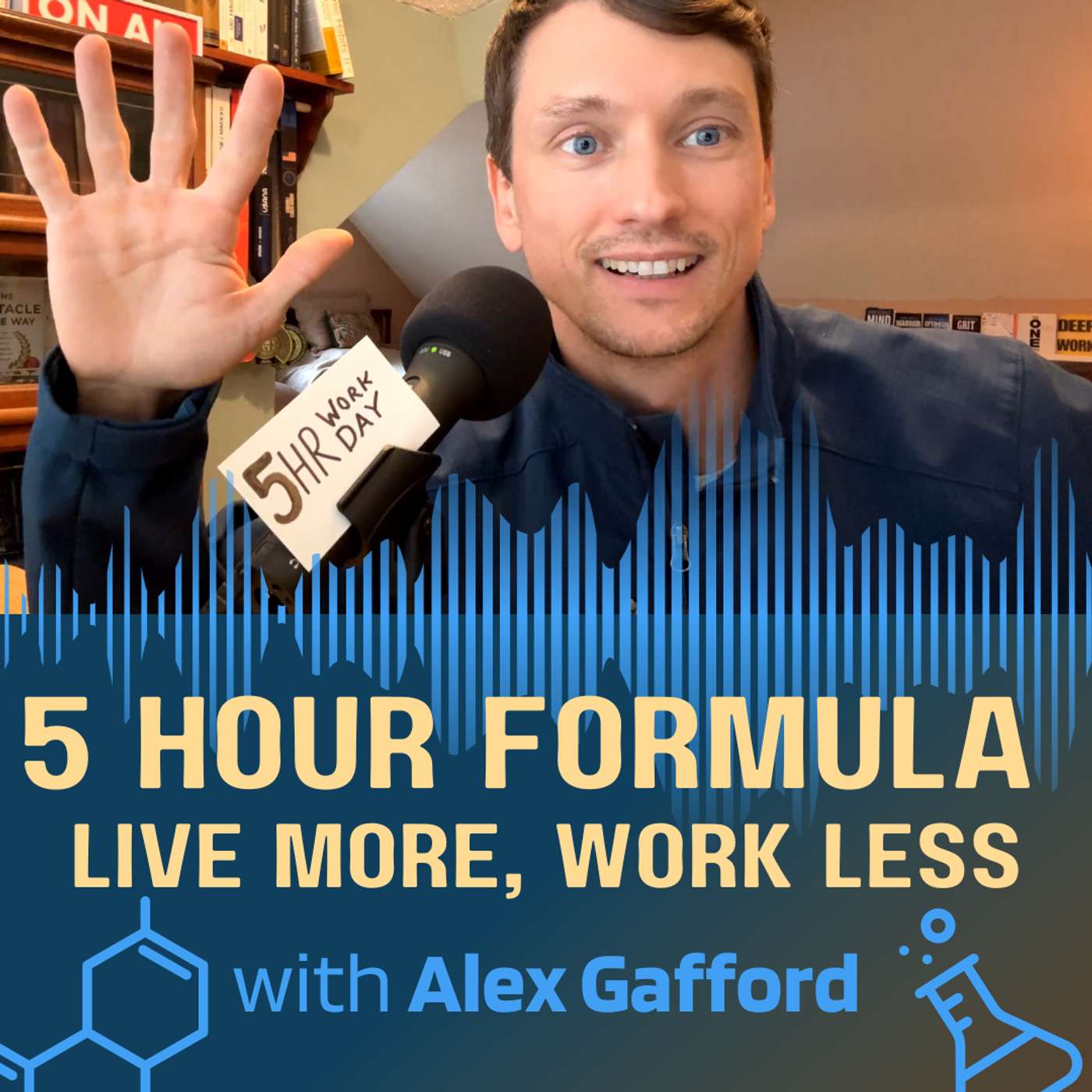
5-Hour Formula: Live More, Work Less

[#14] Alex Pang: Work Less, Rest More - Achieve World-Class Results

11 Nov 2025

Description

Futurist and author Alex Soojung-Kim Pang joins Alex Gafford to unpack why the most productive people and teams don’t work more, they work better. We dive into Pang’s trilogy (The Distraction Addiction, Rest, Shorter), the research behind 4–5 hours of daily deep work, and how design thinking turns shorter-hours experiments into durable operating systems. We also explore AI’s role, global adoption trends, and practical steps any leader can take this quarter.Why listenLearn the science behind the “~4 hours of deep work” ceiling — and how elite performers pair it with deliberate rest.See how shorter-hours experiments solve real problems: retention, burnout, recruiting, founder sanity.Steal the cadence: protected focus blocks → deliberate breaks → lighter admin.Get a realistic view of AI: tool for climbing the value chain vs. blunt headcount cuts.Walk away with a 6-step playbook to pilot a shorter week or shorter day.Highlights & timestamps00:00 – Welcome & Origin StoryHow Blue Street and Pang first connected; pre-pandemic “are we crazy?” moments and why that skepticism faded.01:13 – Not Just TechShorter profiled 100+ companies across law, manufacturing, professional services — proof the movement isn’t lifestyle-only.04:05 – Real Business DriversRetention and recruiting pressure → time as a benefit; burnout in high-pressure industries.06:32 – Asia’s Pushback on OverworkJapan/Korea examples; cultural headwinds and 1,000-person organizations experimenting with reduced hours.09:01 – Keep It an ExperimentWhy the model works best as a continuing experiment (not an entitlement) — and how that mindset fuels improvement.10:00 – From Rest to CultureBlue Street’s book-club takeaways → company rituals: 90-minute deep-work sprints followed by devices-down walks.14:15 – The Trilogy’s ArcThe Distraction Addiction (attention design) → Rest (recovery for brilliance) → Shorter (scaling it organization-wide).18:25 – Training AnalogyPerformance rises when recovery rises; why sleep quality and mid-day movement aren’t “nice-to-haves”.20:41 – The “Four Hours” ChapterDarwin, Dickens, scientists, composers: repeated pattern of 4–5 hrs/day of truly deep work.21:41 – Reframing the 10,000-Hour RuleEricsson’s data: ~4 hrs/day of deliberate practice plus ~12,500 hrs deliberate rest and ~30,000 hrs sleep over a decade.24:52 – Layering Deep Work + Deliberate RestWalks and active breaks amplify problem-solving via the default mode network.32:01 – Design Thinking for Work-Time ReductionHow Pang structures Shorter: iterate, test, codify — and how leaders can apply it personally and organizationally.38:59 – Future of Work & AIAI enables time dividends if implemented by workers to climb the value chain; beware “consultant-driven” headcount cuts.44:06 – Scale & AdoptionPang now sees ~1,000+ orgs operating with reduced hours at same pay across sizes and sectors.45:21 – Big-Company PatternsCase approach: local pilots (e.g., stores/departments), heavy measurement, de-risk, then scale.46:32 – Four-Day vs. Shorter DaysWhy 4DWs sell easily, but 5–6 hour days better fit school schedules and cognitive ceilings; both models work.50:40 – What Pang’s Building NowConsulting with nonprofits; free open-access program to help teams design shorter-hours trials.51:27 – Where to StartAccess Pang’s open course and reach out for organizational design support (links in Resources).The playbook (quick start)Protect Deep Work (90 mins x 2–3/day): No Slack, phones, or meetings. Door-closed norms apply to everyone, senior leaders included.Layer Deliberate Rest: After each sprint, 10–20 minutes of devices-down walking, light movement, or nature.Right-size Meetings: Default 15 minutes. Require purpose + pre-read. End early on principle.Design Thinking Cadence: Pick a team → define constraints → run a 6–12 week pilot → measure output/quality/CSAT → codify → expand.Make It an Experiment, Always: Treat reduced hours as earned via outcomes; iterate policies quarterly.Aim AI at the Busy Work: Have workers choose where AI removes drudgery so they can spend more time on high-value work and bank some of the time as free time.Best Quotes from Alex Pang:“The only bad shorter workweek is the one you don’t implement.” “Top performers don’t just practice more — they rest more and sleep better.”“Keep it an experiment — that’s how you prevent entitlement and keep improving.”“AI can enable a four-day week — but only if we choose to spend the time dividend well.”Resources & mentionsBooks by Alex Soojung-Kim Pang: Shorter, Rest, The Distraction Addiction.Research: Anders Ericsson (deliberate practice); reinterpreting the “10,000 hours” rule.Case contexts: Netherlands/Nordics (shorter days), Japan/Korea moves, Medibank pilots, Iceland & UAE public-sector shifts.Blue Street Capital practices: 90-minute deep-work sprints + devices-down walking breaks.Get started: Alex Pang’s free open-access shorter-workweek program (via Four Day Week Studio).Related: #WorkSchoolHours by Dr. Ellen Joan Ford (ties to school-hours alignment for parents).Connect with Alex PangFour Day Week Studio-  (free program + consulting).Work with Alex: Organizational pilots for nonprofits and mission-driven orgs.Connect with 5-Hour FormulaSubscribe for new episodes + 5-Hour Formula Notes (concise 4–6 page book overviews).Join the newsletter + resources library.Share this episode with a leader who’s wrestling with retention, burnout, or “do more with less.”CreditsHost: Alex GaffordGuest: Alex Soojung-Kim PangTheme: Getting more done in less time — and reinvesting the saved hours in what matters most.

Audio
Featured in this Episode

No persons identified in this episode.

Transcription

This episode hasn't been transcribed yet

Help us prioritize this episode for transcription by upvoting it.

0 upvotes
🗳️ Sign in to Upvote

Popular episodes get transcribed faster

Comments

There are no comments yet.

Please log in to write the first comment.